
Hikers, campers, and outdoor explorers
How to Plan Outdoor Adventures Around Daylight and Seasonal Changes
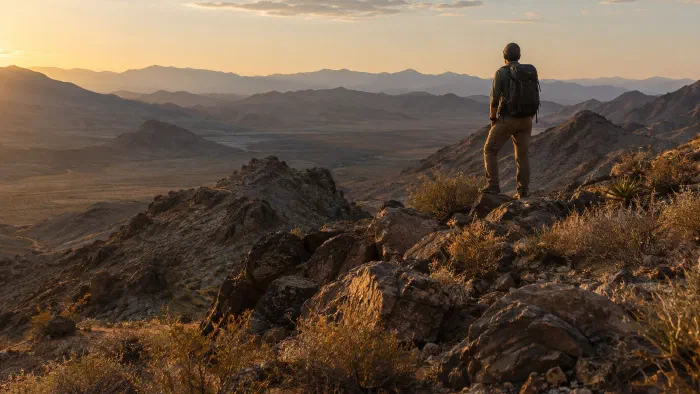
Short answer: plan backward from sunset, start early in hot weather, and check how the season is changing your daylight week to week. Then confirm conditions — forecast, park alerts, and air quality — from official sources before you go.
Solunex™ is a visual reference for natural time and local conditions. It is not a navigation, forecasting, or safety tool. Always use official sources and carry the right gear.
Step 1: Plan backward from sunset
The most common mistake on day hikes is running out of light on the way back. Avoid it by planning in reverse:
- Find sunset at the trailhead, not at home. Location within a time zone can shift it by many minutes.
- Estimate your return time. Most people move slower on the way back, especially downhill on loose ground.
- Set a turnaround time. Turn around at that time even if you haven't reached your goal.
- Keep twilight as a buffer. Civil twilight usually adds 25–35 minutes of usable light at mid-latitudes — but don't plan to use it.
Example
Sunset at the trailhead is 5:48 PM. Your return leg takes about 2 hours, and you want a 30-minute margin. Your turnaround time is 3:18 PM.
Step 2: Use the shape of the day's temperature
Temperature follows a fairly reliable daily curve. It's usually lowest around sunrise and highest in the mid to late afternoon, often a few hours after solar noon.
That's why desert hikers in places like Red Rock Canyon or Valley of Fire often start at first light. The early hours give the coolest temperatures and the softest light, and you're done before the afternoon peak.
Check the National Weather Service for heat advisories before any summer hike.
Step 3: Check air quality
Air quality changes from day to day and through the day. Wildfire smoke can travel hundreds of miles, and ozone often rises on hot, sunny afternoons.
The U.S. Air Quality Index (AQI) runs from 0 to 500. Values from 0–50 are "Good" and 51–100 are "Moderate". Above 100, conditions may affect sensitive groups first. Check AirNow.gov on the morning of your trip.
Step 4: Adjust for the season
Daylight doesn't change at a steady pace. It shrinks fastest around the September equinox and grows fastest around the March equinox. In practice:
- Spring: evenings lengthen quickly. Routes open up week by week.
- Summer: long days, but heat often pushes the best hiking to early morning.
- Autumn: light disappears fast. A route that worked three weeks ago may now run into dusk.
- Winter: short days. Midday becomes your main window, and the earliest sunsets come in early December.
Step 5: Factor in terrain
Official sunset assumes a flat horizon. Canyon floors, east-facing slopes, and dense forest lose direct sun earlier. If your route ends in a canyon, move your turnaround time earlier.
Step 6: Think about the moon for evening trips
If you're camping or planning a sunset hike, the moon changes what the evening looks like. A full moon rises around sunset and lights the landscape all night. A new moon means a dark sky — great for stars, but harder for seeing terrain. Learn more in understanding moon phases.
A quick pre-trip checklist
- Sunset time at the trailhead
- Turnaround time, written down
- Today's temperature curve and any heat advisory
- Air quality (AQI)
- Park or trail alerts
- Headlamp, water, layers, and a way to contact help
Seeing it all in one place
Solunex™ brings the natural parts of this checklist onto one dial. The solar ring shows the daylight arc, the temperature ring shows the day's warmth hour by hour, the air quality ring shows how clean the air is through the day, and the lunar ring shows the moon. You can switch to any city to preview a destination before you leave.